
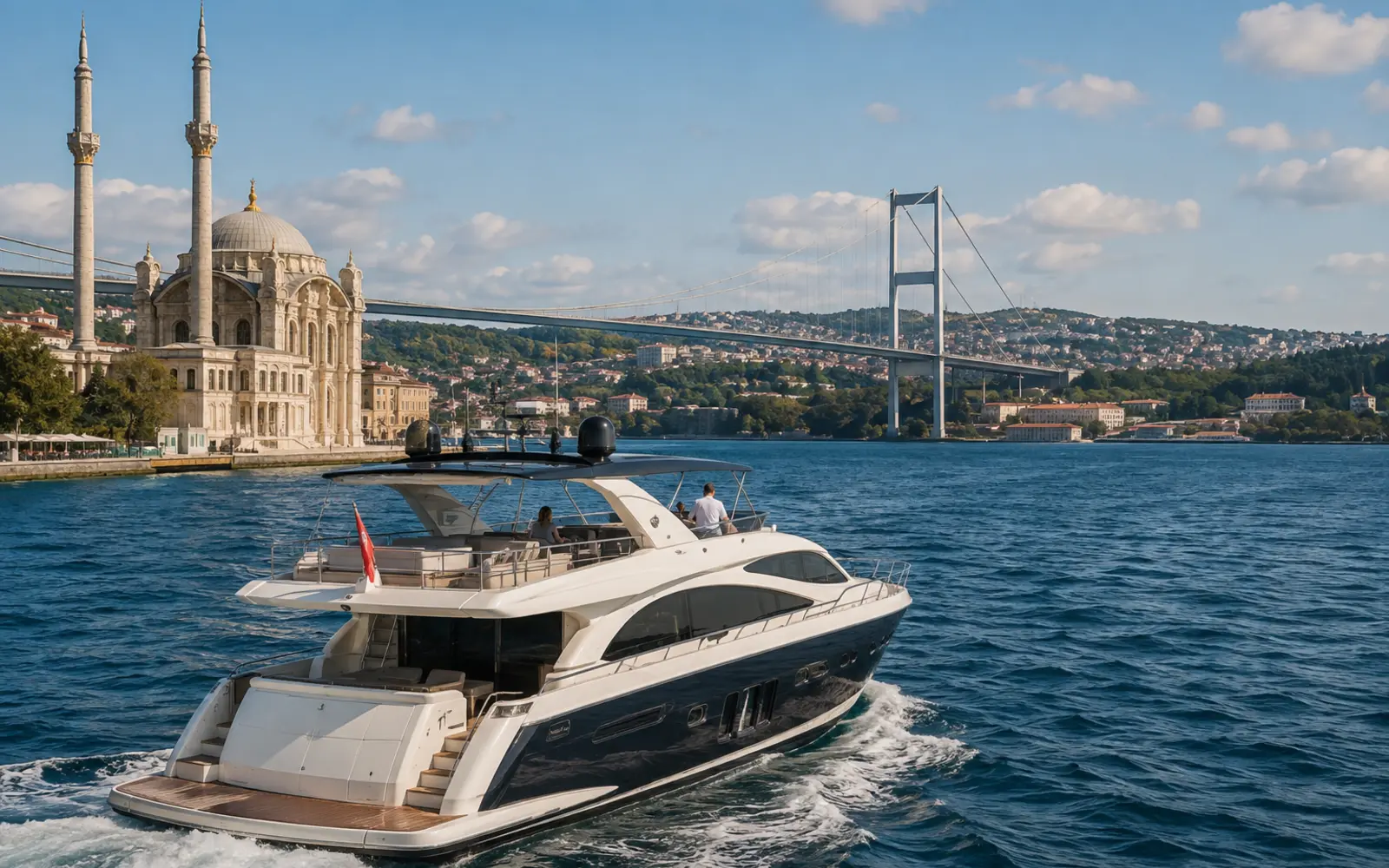
Plan a Bosphorus yacht route linking Ortakoy, Beylerbeyi, Bebek, the two fortresses and Kucuksu Pavilion.
Why this stretch works well for a Bosphorus cruise
The stretch between Ortakoy and Rumeli Fortress places several of the Bosphorus’s best-known sights within a relatively concentrated cruising area. The route name does not mean that boarding must take place in Ortakoy; the starting pier depends on the yacht’s berth, guest access and pier availability that day. A cruise can be shaped to take in Ortakoy Mosque and the 15 July Martyrs Bridge before continuing past Arnavutkoy and Bebek toward Rumeli Fortress. When conditions and the operational plan allow, the return leg can move closer to the Asian shore and add Beylerbeyi Palace, Anadolu Fortress, Goksu and Kucuksu Pavilion to the story. This makes it possible to understand how palaces, waterfront homes, bridges and fortresses face one another instead of following only one bank. It is a balanced first private cruise and also suits guests interested in architecture or photography. The broader Istanbul Bosphorus Yacht Route page can help place this section within a longer itinerary.
Open with Ortakoy, the bridge and Beylerbeyi
Ortakoy is one of the route’s most recognisable scenes because the mosque’s waterside façade and the bridge span can be seen within the same area. The composition changes quickly with the yacht’s direction and surrounding traffic: one angle gives the mosque prominence, while another turns the bridge into a wide frame joining the two shores. Across the water, Beylerbeyi Palace stands near the Asian foot of the bridge. According to the Directorate of National Palaces, the present main building was constructed in 1863–1865 during Sultan Abdulaziz’s reign and served as a summer residence and state guest house. Its long shoreline façade and marine kiosks explain why it reads particularly clearly from the water. Rather than requesting a fixed stopping position for a photograph, use a wider frame while the captain follows an appropriate course. Giving Ortakoy, the bridge and Beylerbeyi separate short shooting windows usually produces cleaner images than forcing all three into a single frame.
Follow the waterfront texture from Arnavutkoy to Bebek
North of the bridge, the European bank becomes more intimate through Arnavutkoy, Kurucesme and Bebek. Waterside houses, small piers, wooded slopes and everyday life along the shore reveal the residential character of the Bosphorus after the monumental opening. Looking across toward Kandilli and Cengelkoy as well as along the near bank makes the width and bends of the strait easier to appreciate. The Bebek area is also a practical meeting zone for many private cruises, although the exact boarding point should be shared in the booking confirmation. When comparing yachts on the Yacht Charter page, consider an unobstructed open-deck view together with sufficient indoor space. Mention camera bags, a stroller or event materials in advance so that passageways can remain clear. On a quiet sightseeing cruise, a service flow that does not interrupt the views may suit the experience better than a loud, tightly timed programme.
Read Rumeli and Anadolu fortresses as a pair
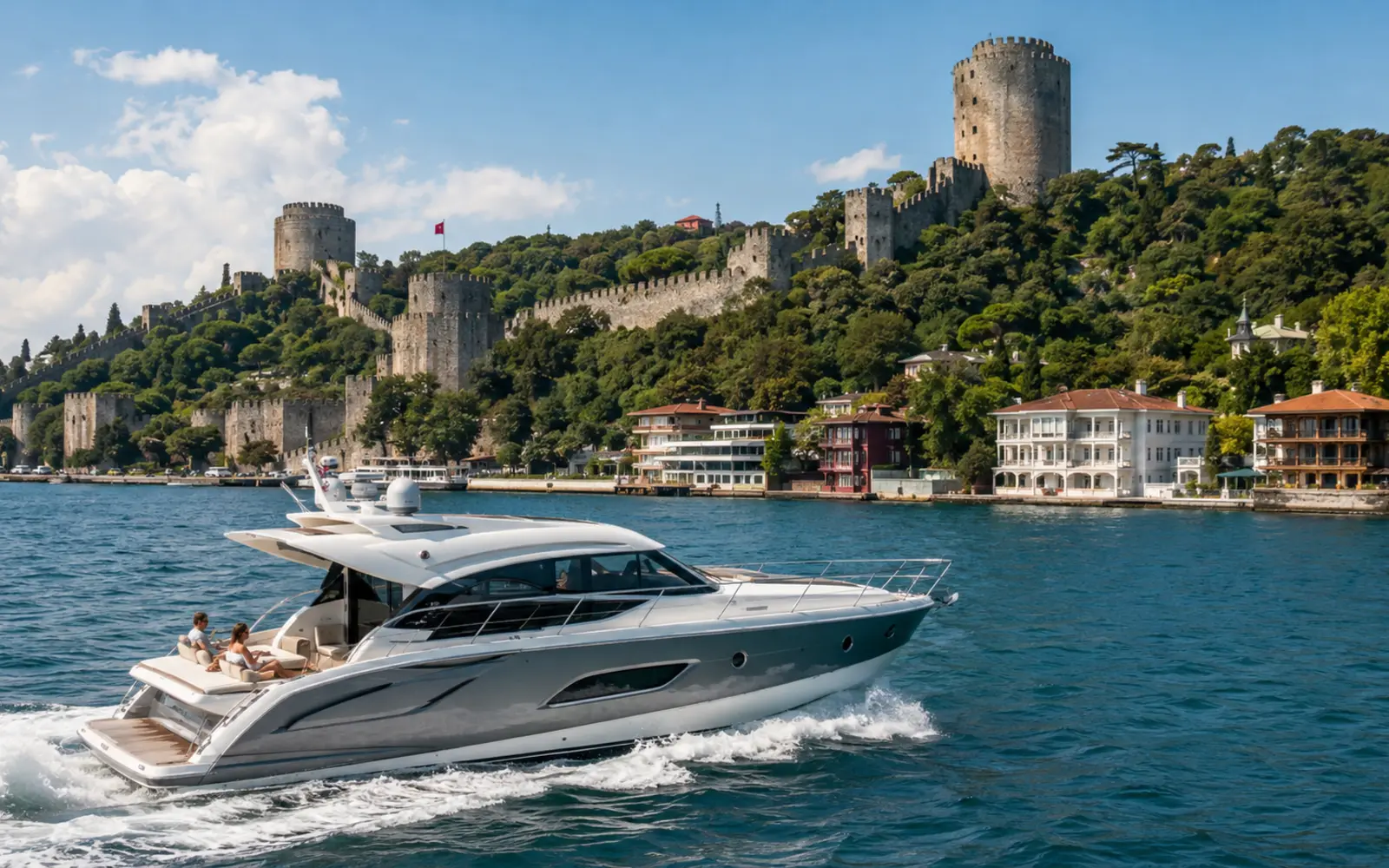
In the northern part of the route, Rumeli Fortress rises on the European side while Anadolu Fortress stands opposite near the point where Goksu Creek reaches the Bosphorus. Istanbul Metropolitan Municipality’s Cultural Heritage record states that Anadolu Fortress was built by Bayezid I in 1395 and was strengthened when Mehmed II built Rumeli Fortress across the strait in 1452. This context turns the structures from separate photo stops into a historical pair connected with control of the waterway. As the yacht passes Rumeli Fortress, the towers’ relationship with the hillside is especially clear; turning toward the opposite shore reveals the smaller scale of Anadolu Fortress within its surrounding neighbourhood. Current, commercial vessel traffic and the captain’s navigation decision can change the passing distance. It is therefore more sensible to note both fortresses as viewing priorities than to promise a stationary position in front of one tower.
Let Kucuksu and Goksu enrich the return leg
A return near the Asian shore adds another architectural layer when Kucuksu and Goksu fit the conditions and timing. The Directorate of National Palaces explains that the meadow between the Goksu and Kucuksu streams was an imperial garden and popular recreation area, and that today’s Kucuksu Pavilion was built in 1856–1857. Its ornamented seaward façade makes the relatively small building easy to distinguish from the water. Seen with nearby Anadolu Fortress, it brings defensive architecture, waterside recreation and palace design into one compact section of shoreline. Including this view does not mean the yacht will berth or guests will go ashore. Any shore visit must be considered separately for pier access, duration and operational permission. For a cruise-only plan, sharing which buildings matter most with the captain and operations team helps create a more meaningful return line.
Plan timing, photographs, weather and booking details together
There is no single best hour for this route. Daylight makes façade details and waterfront colours easier to see, while a lower sun may create stronger layers of shadow between bridges, houses and hills. Because the direction of light changes with the season and the yacht’s position, do not build the entire plan around one guaranteed photograph. A clean lens, a wider composition and a short shutter speed are practical on a moving yacht, but photography should never block deck passage. Check the Turkish State Meteorological Service’s marine forecast for the Marmara before the cruise, while treating the captain’s current assessment as decisive for the actual operation. In the booking request, give the date, start time, guest count, priority landmarks, dining or refreshments plan and photography needs together. Compare the yachts on /yat-kiralama/ for their open and indoor areas, then confirm the final route and service scope in writing.
Sources and further reading
- Beylerbeyi Palace: history and locationT.C. Cumhurbaşkanlığı Millî Saraylar Başkanlığı
- History of Anadolu Fortressİstanbul Büyükşehir Belediyesi Kültürel Miras
- Kucuksu Pavilion: history and architectureT.C. Cumhurbaşkanlığı Millî Saraylar Başkanlığı
- Three-day marine forecast for the MarmaraMeteoroloji Genel Müdürlüğü