
A practical guide to seeing Dolmabahce Palace from the Bosphorus, with history, architecture, viewing direction, photo tips and nearby stops.
A long palace frontage on the lower Bosphorus
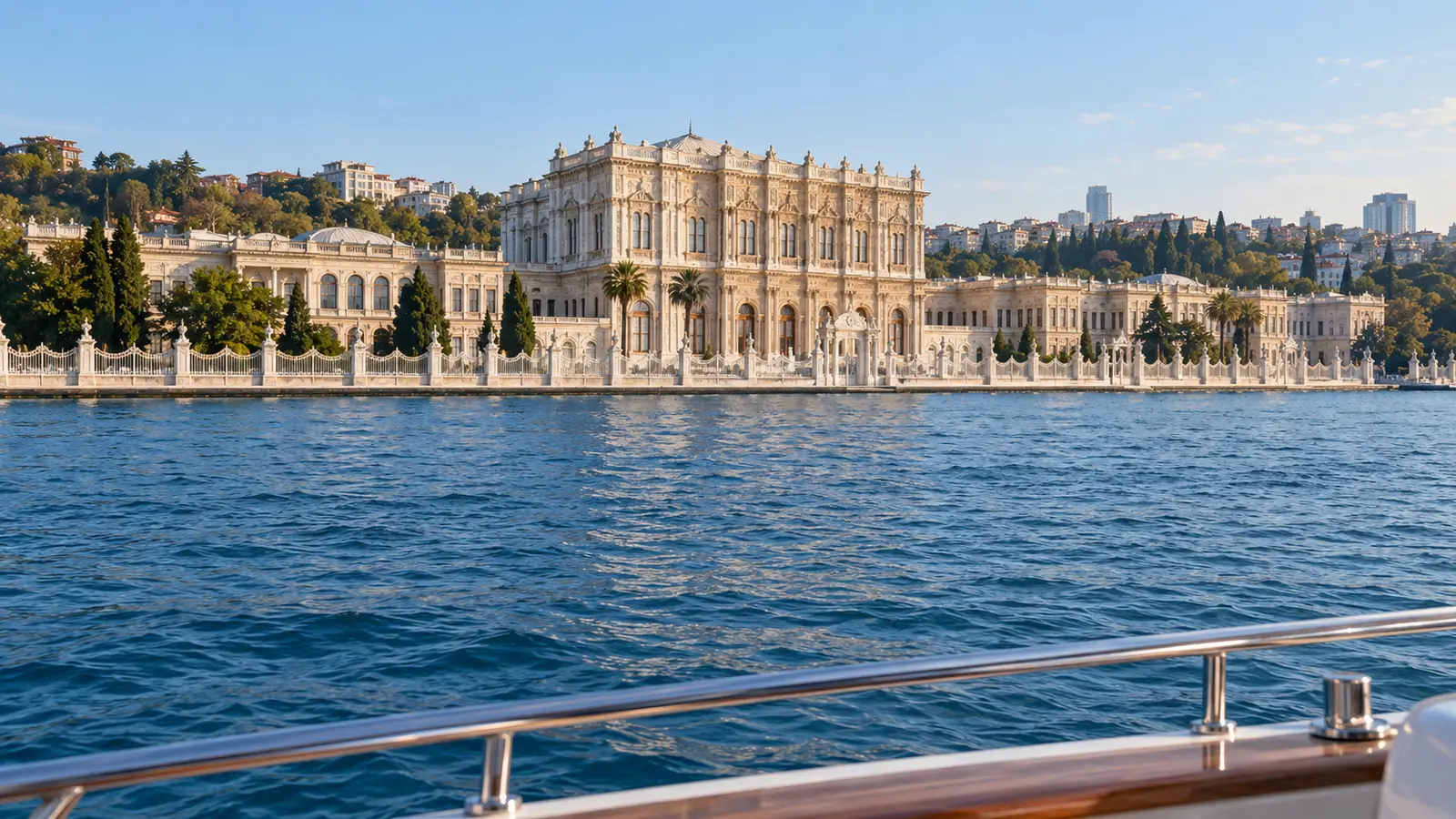
Dolmabahçe Palace stands on Istanbul’s European shore in Beşiktaş, just north of Kabataş and south of the Çırağan–Ortaköy stretch. It is one of the first major landmarks encountered on many lower-Bosphorus cruises. From land, the complex appears in separate pieces; from the water, most of its long frontage unfolds at once. Its shoreline alignment, pale stone façade, waterfront gates and trees can share a single frame. Dolmabahçe is therefore more than a palace to tick off a list: it is a place where Istanbul’s changing nineteenth-century image can be read directly along the waterline.
From a natural bay to an imperial palace
According to the Directorate of National Palaces and Türkiye’s Ministry of Culture and Tourism, the area began as a natural bay that was gradually filled from the seventeenth century and turned into an imperial garden; the name Dolmabahçe is associated with this transformation. Beşiktaş Waterfront Palace previously occupied the site. The foundations of today’s palace were laid in 1843 during the reign of Sultan Abdülmecid, and the building came into use in 1856. Karabet Balyan, Nikogos Balyan and other court architects took part in its design and construction. Besides witnessing the final period of the Ottoman dynasty, the palace has a special place in Republican history because Mustafa Kemal Atatürk used it as a residence and workplace in Istanbul.
How to read the waterfront façade
The main building runs parallel to the Bosphorus and is organised functionally into the Mabeyn-i Hümâyûn, the Ceremonial Hall and the Imperial Harem. From a boat, begin with the taller monumental mass near the centre, then follow the calmer rhythm extending to both sides. Waterfront gates, stone railings and repeated windows reveal how deliberately the palace addresses the shore. Its architecture brings a traditional Ottoman palace and house plan together with Baroque, Rococo and Neoclassical decorative influences. On a moving yacht, following the whole silhouette and the transitions between sections often explains the building better than concentrating on a single ornament.
Viewing direction and a practical photo plan
When cruising south, the palace remains on the starboard side; when heading north, it is on the port side, always along the European shore. For the clearest reading of the façade, point the camera westward from the water toward Beşiktaş. Use a wide view for the full complex, then a longer focal length for the stonework around the Ceremonial Hall and the waterfront gates. Morning light may produce a more even façade, while afternoon shadows vary by season. Use a fast shutter speed, keep phones and cameras away from the rail edge, and stay within the area indicated by the captain. Bosphorus traffic means a yacht should not be expected to hold a fixed position directly in front of the palace.
Complete the route with nearby landmarks
Dolmabahçe becomes more meaningful when read with its neighbours. Dolmabahçe Mosque and Kabataş lie to the south; the Beşiktaş waterfront, Naval Museum and, farther north, Çırağan Palace form the next sequence. A short Dolmabahçe–Beşiktaş–Çırağan passage shows how palace architecture changes along the shore, while a longer itinerary can continue to Ortaköy. Our Istanbul Bosphorus route page helps place these sights in order, and the yacht charter page lets you compare boats by group size and duration. Mentioning that photography at Dolmabahçe is a priority in your reservation request helps the captain shape the passage accordingly when weather and traffic permit.
Sources and further reading
- Dolmabahce Palace: official history and architectureT.C. Cumhurbaşkanlığı Millî Saraylar Başkanlığı
- Istanbul — Dolmabahce PalaceT.C. Kültür ve Turizm Bakanlığı
- Dolmabahce Palace visitor overviewİstanbul Büyükşehir Belediyesi — Visit Istanbul