
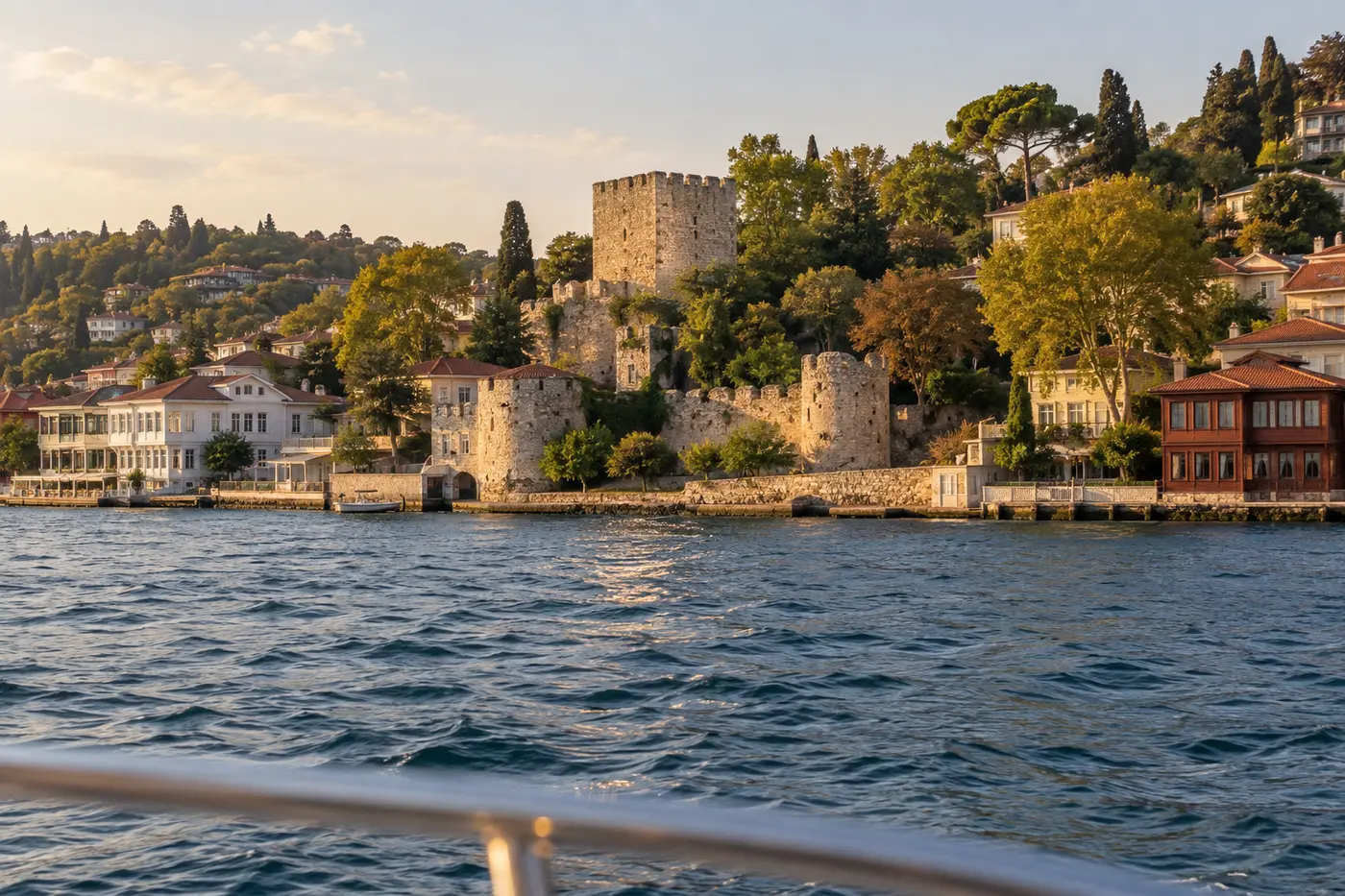
Discover Anadolu Fortress from the Bosphorus: its history, route position, best yacht viewpoint, photo light and nearby landmarks.
Why is seeing Anadolu Fortress from the Bosphorus distinctive?
Seeing Anadolu Fortress from the Bosphorus reveals more than a solitary castle. It shows how the structure relates to the mouth of Göksu Creek and the neighbourhood that grew around it. Unlike the broad monumental silhouette of Rumeli Fortress, Anadolu Fortress appears compact and woven into the waterfront settlement. Its square keep, lower defensive walls and tree-framed bastions fit into one view from a moderate distance. As the yacht moves, the contrast between the stone mass and nearby waterfront houses becomes clearer. This brief encounter brings the Bosphorus’s military history and its changing shoreline into the same landscape.
From Bayezid I to the defences of 1452
The TDV Encyclopaedia of Islam records that Bayezid I commissioned the fortress in the late fourteenth century to control passage through the Bosphorus. Historical sources give different dates between 1390–91 and 1394–95, so assigning one certain year would be misleading. The earliest structure consisted of the square keep and a tighter defensive enclosure. When Mehmed II built Rumeli Fortress in 1452, he also strengthened Anadolu Fortress on the waterfront with additional walls and towers. Together, the two fortresses formed a defensive arrangement across the narrow section of the strait. Its military role declined after the conquest of Istanbul, but it remains a visible trace of early Ottoman military architecture.
Where does Anadolu Fortress appear on a Bosphorus route?
The fortress stands on the Asian shore where Göksu Creek reaches the Bosphorus, south of the Fatih Sultan Mehmet Bridge. On a northbound yacht from Beylerbeyi, it appears on the starboard side immediately after Küçüksu Pavilion. On a southbound route from Kanlıca, look to port as the yacht approaches the Göksu waterfront. Rumeli Fortress faces it from the European shore across the same narrow reach. Currents, marine traffic and the captain’s safe navigation plan affect the distance from shore, so mention priority landmarks before booking to help allocate the route time sensibly.
Choose the right yacht viewpoint and framing
A moderate distance is usually more useful than passing extremely close because it keeps the main tower, lower wall fragments, creek mouth and neighbourhood in one frame. Starboard generally offers the clearest view when travelling north; port is the natural side when heading south. A frontal view emphasises the compact plan, while a slight diagonal shows the depth between the keep and smaller towers. With a wide-angle lens, avoid pushing the fortress to the edge of the frame, where lines can bend. Short bursts, a level horizon and clear deck walkways make photography cleaner and safer on a moving yacht.
Use afternoon light to reveal the stonework
The Asian shoreline and the fortress’s water-facing surfaces become more legible when western light reaches them in the afternoon. Warmer light toward sunset can bring out the varied stone tones and uneven wall texture, whereas morning often leaves the structure in deeper shade against a brighter sky. Light cloud can soften contrast and preserve detail in both the tower and surrounding trees. Instead of depending on one exact minute, photograph during the approach, the broadside view and the departure to create a more useful sequence.
Complete the route with Küçüksu and Rumeli Fortress
Nearby landmarks make the history easier to read. Küçüksu Pavilion immediately to the south creates a sharp transition from military architecture to nineteenth-century court life. Rumeli Fortress on the opposite shore allows a direct comparison of scale and position. With suitable cruise time, all three can be viewed in sequence, although weather and marine traffic may alter the sailing plan. A yacht cruise does not include landing or admission to the fortress. If you plan a separate land visit, check current access information with the relevant institution.
Frequently asked questions
Which shore of the Bosphorus is Anadolu Fortress on?
It stands on the Asian shore where Göksu Creek meets the Bosphorus, south of the Fatih Sultan Mehmet Bridge.
Which side of the yacht offers the view?
It is generally on starboard when sailing north and port when sailing south; the captain’s safe navigation plan determines the exact track.
Does a yacht cruise include entry to Anadolu Fortress?
No. The route is for viewing it from the water; landing and any land visit must be arranged separately.
Sources and further reading
- Anadolu Fortress entryTDV İslâm Ansiklopedisi
- History and architecture of Anadolu FortressTürkiye Turing ve Otomobil Kurumu